


New research reveals PainChek AI-powered pain assessment delivers measurable financial returns for care providers

05 June 2026
An independent study by Casson Consulting has delivered one of the most comprehensive analyses to date of the financial and operational impact of digital health technology in social care, revealing that PainChek can increase care home turnover by up to 2% through improved occupancy stability and proactive care.
The findings highlight a compelling commercial case for adoption. Based on 2026 benchmarks, a typical 100‑bed UK care group operating at 88–90% occupancy with a balanced mix of private and local authority residents generates around £5.5 million in annual revenue1,2,3,4. A 2% uplift would mean generating an additional £110,000 per year, driven by fewer avoidable discharges and greater continuity of care.
Crucially, this additional income comes at minimal cost. PainChek averages just 10p per bed per day, equating to £3,650 annually for a 100‑bed group, demonstrating PainChek costs approximately 3.3% of turnover benefits whilst simultaneously improving resident outcomes.
PainChek is the world’s first regulatory-cleared medical device that uses artificial intelligence and facial analysis technology to assess pain in individuals who cannot reliably self-report, such as those with dementia. The research study was led by Daniel Casson, an independent consultant working at the intersection of social care, innovation, and new technology.
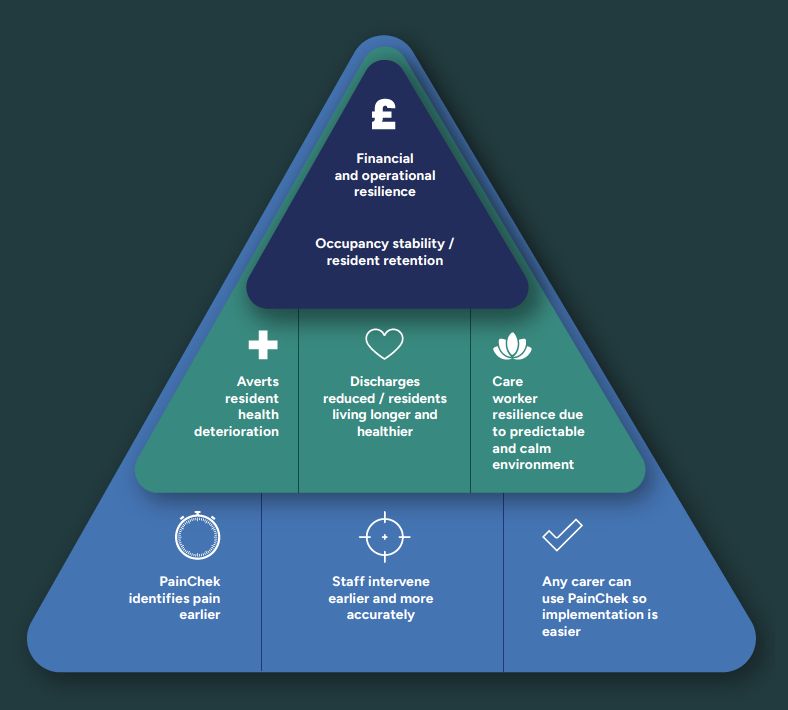
While PainChek has had robust clinical evaluations evidencing profound improvements in clinical outcomes, its financial return on investment had not previously been assessed.
Casson Consulting worked with three diverse care providers, comprising of more than 1,100 residents across England and Scotland. A significant dataset was evaluated, comparing metrics from six months prior and six months post implementation of PainChek.
The research findings demonstrate that implementation of PainChek helped the surveyed care home operators to keep residents within their care homes for longer, by reducing the risks that lead to individuals being discharged due to unmet needs or admitted to hospital due to deterioration. Statistics from the report include up to:
- 50% fewer hospital admissions.
- 59% reduction in ambulance call outs.
- 48% reduction in falls.
- 41% reduction in pressure ulcers
- 64% fewer resident discharges due to unmet care needs.
- 88% reduction in safeguarding incidents
- 57% fewer UTIs due to early identification of discomfort.
- 46% fewer cases of malnutrition.
Tandeep Gill, General Manager and Head of Business Development UK atPainCheksaid:“Successful care providers are dependent on maintaining high levels of occupancy through the highest quality-of-care delivery.
“PainChek gives providers a clear commercial advantage by enabling anticipatory care; reducing avoidable disruption and increasing revenue. The impact is short-term and measurable, residents stay within placements for longer, discharges fall, and occupancy strengthens.
“An uplift of 2% in turnover is significant as it unlocks meaningful capital that can be reinvested into workforce, leadership, and care delivery, driving further performance improvements while ensuring every resident’s pain is recognised and effectively managed.
“In a market under increasing pressure, the providers that succeed will be those that turn better care into stronger, more predictable financial outcomes.”
Daniel Casson, Managing Director at Casson Consulting adds: “The project’s scope was intentionally narrow: to quantify the direct cashbenefits of adoptingPainChek. Yet the care groups involved consistently highlighted a wider set of benefits.
“My analysis supports theview that one ofPainChek’smost significant contributions is its abilityto strengthen the financial resilience of a care home by supportingpeople to live longer, healthier lives with a good quality of life.
“Care home operators are under increasing pressure to demonstrate clear, evidence-based return on investment in digital and AI-based technologies. Credible evidence in this area will help technologies such as PainChek to achieve adoption more widely, truly changing the effectiveness and efficiency of care home operations.
“I believe that this groundbreaking research sets a new line in the sand and should be a launchpad for even more in-depth research to validate the extent to which PainChek improves people’s wellbeing while establishing greater financial resilience for care homes.”
To view the Casson Consulting report in full, visit the PainChek website here.
For more information, visit: https://painchek.com
References
- https://www.carehome.co.uk/advice/care-home-fees-and-costs-how-much-do-you-pay
- https://www.treatcompare.com/care-costs
- https://www.carehome.co.uk/advice/care-home-cost-guide-to-london-2026-what-youll-pay-and-how-funding-works
- Knight Frank, UK Care Homes, Trading Performance Review 2025, knightfrank.com/research
Share this page:
Partners & Associates






Contact our team
01625 520 320
Discuss how our team can help you


